

Table of Contents
- Building a Functional Gear Kit for Your Land
- The Right Tools for Daily Acreage Management
- Choosing Durable Outdoor Clothing for Land Management
- Must-Have Equipment for Small Acreage, From Fence Lines to Food Plots
- Safety Gear and PPE: Non-Negotiable Essentials
- How to Maintain Outdoor Gear and Extend Its Life
- Budgeting Smart: New vs. Used and Financing Options
- Conclusion: Your First Season With the Right Gear
- Frequently Asked Questions
Last Updated: September 4, 2026
Building a Functional Gear Kit for Your Land
Stepping onto raw acreage is equal parts promise and problem. The difference between a property that thrives and one that overwhelms comes down to whether you own the right functional gear for land owners before you need it. At Rack & Ridge, we build an outdoor collection for people who measure their weekends in work accomplished. Below, we’ll show you how to assemble a kit that matches your acreage, goals, and budget.
The core principle is simple: buy for the work you actually do, not the work you imagine. Before spending a dime, walk your land and list the recurring tasks: clearing brush, mowing pasture, hauling firewood, checking fences, or maintaining food plots. This guide covers the categories that solve those problems, with honest advice on where to save and where to invest.
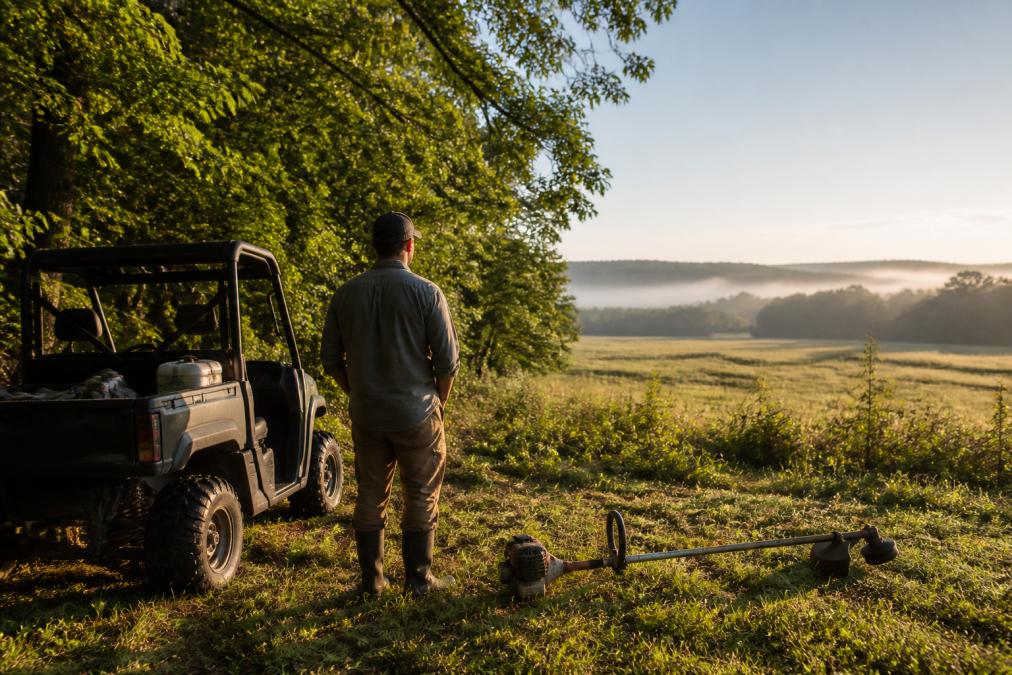
The Right Tools for Daily Acreage Management
Daily management is about efficiency. For most owners, this means building a stable of equipment that handles three core jobs: clearing, cutting, and hauling.
Land Clearing and Vegetation Control Basics
Vegetation control is the first battle every landowner fights. A quality brush cutter handles saplings and thick undergrowth a standard mower cannot touch. For larger areas, a rotary mower on a compact tractor clears pasture. A chainsaw is non-negotiable for fallen trees and firewood, and a pole saw extends your reach for high limbs. The PTO and three-point hitch turn a compact tractor into a multi-tool platform.
Mowing, Hauling, and Utility Transport
A zero-turn mower cuts mowing time dramatically on open lawn areas, while a compact tractor with a finishing mower handles rougher terrain. For hauling, a UTV with a dump bed moves feed and tools, and a utility trailer handles larger loads of gravel, mulch, or timber. Tractor forks transform your loader into a lifting machine for pallets and heavy debris.
Choosing Durable Outdoor Clothing for Land Management
Durable outdoor clothing for land management is a safety feature, not a fashion statement. Look for reinforced knees and elbows, ripstop materials, and layers that manage moisture. Your kit should include heavy-duty work pants, a breathable long-sleeve shirt, and a waterproof shell. Quality leather gloves protect your hands, and broken-in, waterproof boots with good ankle support prevent injuries on uneven terrain.
This is where Rack & Ridge earns its place. Our collection pairs rugged, outdoor-inspired style with pieces that hold up to real use, so you can move from the truck to the tree stand without changing your whole wardrobe. Gear that lasts multiple seasons reduces both cost and waste.
Must-Have Equipment for Small Acreage, From Fence Lines to Food Plots
Small acreage, typically under twenty acres, demands versatile tools rather than a fleet of specialized machines. A walk-behind brush cutter clears fence lines a tractor cannot reach. A measuring wheel lays out fence runs and food plots. A game camera monitors wildlife if you manage for hunting. A portable generator powers tools and provides backup. For food plots, a compact tiller or disc attachment prepares soil without requiring a full-size implement.
Safety Gear and PPE: Non-Negotiable Essentials
Working the land carries real risk, and personal protective equipment is the cheapest insurance you will ever buy. Hearing protection is mandatory when running a chainsaw or tractor for hours; the cumulative damage is permanent. Safety glasses or goggles protect against flying debris from brush cutters and mowers. Chainsaw chaps and a forestry helmet with a face shield are not optional when cutting timber. Keep a well-stocked first aid kit in your utility vehicle and another in the barn. Leather gloves, steel-toe boots, and high-visibility vests round out a basic safety kit. According to OSHA guidance on agricultural safety, proper training and protective equipment significantly reduce the risk of injury in agricultural work.
How to Maintain Outdoor Gear and Extend Its Life
The most expensive piece of equipment you own is the one that fails mid-season. A regular maintenance schedule prevents maintenance downtime and protects your investment. The real secret to longevity is controlling the environment where equipment sits between uses, rust, fuel degradation, and rodent damage destroy more machines than hard work ever will.
The 10-30-90 Maintenance Schedule
A simple three-tier schedule keeps equipment running without turning maintenance into a second job.
Every 10 hours of use (or after each heavy day):
- Clean mud and debris from mower decks and undercarriages. A pressure washer works, but a stiff brush and a hose are gentler on bearings and seals.
- Check the air filter. A clogged filter starves the engine and increases fuel consumption by up to 10 percent (energy.gov).
- Inspect blades for nicks and dullness. A sharp blade cuts clean; a dull one tears grass, inviting disease and stressing the engine.
- Grease all fittings per the manufacturer's chart. A $5 tube of grease prevents a $500 bearing replacement.
Every 30 hours of use (or monthly):
- Change engine oil and replace the filter. Small engines run hot and the oil breaks down faster than in a car.
- Sharpen or replace blades. A common pattern is to sharpen at the start of the season and once mid-season for every 30 hours of cutting.
- Check and replace the fuel filter and spark plug. A fouled plug causes hard starting and poor power.
- Inspect belts and hoses for cracks, fraying, or glazing. Replace them before they snap mid-job.
Every 90 hours (or quarterly):
- Replace hydraulic fluid and filter on tractors and UTVs. Old fluid loses its lubricating properties and can damage the system.
- Check and adjust valve clearances on engines over 20 horsepower.
- Inspect the battery, clean the terminals, and test the charge. A battery that drops below 12.4 volts when resting is nearing the end of its life.
- Torque all major fasteners, especially on mower decks and attachments.
Storage and Climate Control: The Overlooked Investment
Where and how you store equipment determines its lifespan more than any single maintenance task. Here is what owners with 20-year-old machines do differently:
Fuel management is the #1 cause of small-engine failure. Ethanol-blended gasoline absorbs moisture and separates within 30 to 60 days, leaving a gummy residue that clogs carburetors. If a machine will sit for more than two weeks, add a fuel stabilizer like STA-BIL to the tank, run the engine for five minutes to circulate it, and then either drain the carburetor bowl or run the engine until it stalls. For machines stored over winter, drain the tank completely and run the engine dry.
Rodents are silent destroyers. Mice and squirrels nest in air filters, chew wiring harnesses, and pack exhaust pipes with debris. A machine stored in a field shed is far more vulnerable than one in a sealed barn. Use rodent repellent sachets, place traps near the wheels, and cover the exhaust outlet with a metal cap. Check under the hood before the first start of the season.
Climate control is not just for people. A heated or insulated barn keeps the temperature above freezing, which prevents condensation from forming on metal surfaces overnight. That condensation is the primary driver of rust on mower decks, tractor frames, and implement blades. If you cannot heat the space, at least keep equipment off the bare ground on pallets or rubber mats, and use a dehumidifier in the storage area during humid months.
Battery maintenance matters year-round. A lead-acid battery self-discharges at about 3 to 5 percent per month, faster in heat (batteryuniversity.com). Install a battery tender or maintainer on any machine that sits for more than two weeks. A $30 maintainer extends battery life from two years to five or more.
Seasonal Deep-Clean and Inspection
Twice a year, once before the heavy season and once before winter storage, do a full walk-around inspection of each machine.
- Tire pressure and tread depth
- All fluid levels and condition
- Belt and hose condition
- Blade sharpness and balance
- Grease fittings and pivot points
- Lights, signals, and safety switches
- Frame and welds for cracks
This 45-minute walk-around catches small problems before they become mid-season failures. A single skipped service can lead to a repair bill that far exceeds the cost of the maintenance. Protect the investment, and the equipment will protect your weekends.
Budgeting Smart: New vs. Used and Financing Options
Land ownership is expensive, and equipment is a major line item. The smartest strategy is to buy used for simple, mechanical tools and new for complex, high-use machinery. The real value lies in knowing how to inspect a used machine and structure the purchase so it doesn't break your operating budget.
The Used Equipment Inspection Checklist
When you find a used compact tractor or UTV that looks promising, slow down. A 30-minute inspection can save you thousands. Here is the checklist most experienced owners use:
- Check the hour meter, then verify it. Hours are the single best proxy for wear. A tractor with 2,000 hours and no service records is a gamble; one with 1,500 hours and a dealer logbook is a safer bet. Ask for the service history in writing.
- Look for leaks, not just puddles. Crawl underneath and look for fresh oil or hydraulic fluid on the block, the transmission case, and the front axle. A wet spot on the ground is obvious; a slow seep on the housing is a sign of a failing seal.
- Inspect the tires and wheels. Replacements for rear tractor tires can run $800 to $1,500 each. Check for sidewall cracks, uneven tread wear (which indicates alignment or pressure issues), and rust around the bead.
- Test the hydraulics. With the engine running, cycle the three-point hitch through its full range. It should lift smoothly and hold position without drifting down quickly. A fast drop indicates worn cylinder seals.
- Run the engine cold. A cold start tells you about the glow plugs, the starter, and the battery. White smoke on startup that clears is normal; blue smoke that persists means burning oil.
- Check the PTO. Engage and disengage it several times. Listen for grinding or a slow engagement, which points to clutch wear.
Financing, Insurance, and the Real Cost of Ownership
If you are financing, the numbers matter more than the monthly payment. Equipment financing through a dealer or an agricultural lender like Farm Credit typically runs 5 to 8 percent APR for well-qualified buyers. A shorter term (36 to 48 months) means higher payments but less total interest, and it aligns the loan with the machine's useful life.
Before you sign, ask about gap insurance and whether the lender requires comprehensive coverage. A standard homeowner's policy does not cover a tractor or UTV used for land management. You will need a separate farm or ranch insurance policy or an inland marine rider, typically costing 1 to 3 percent of the machine's value annually. Skipping this coverage is a false economy: a single liability claim can exceed the cost of a decade of premiums.
Where to Buy and How to Negotiate
Local dealer networks are the safest source for used tractors because they typically offer a 30- to 90-day powertrain warranty. Auctions and private sales offer lower prices but zero recourse. If you buy at auction, attend the preview day, bring your checklist, and set a hard ceiling before bidding. Budget 20 percent above the auction price for immediate repairs, tires, hoses, and fluids, that the seller did not address.
For attachments like brush cutters, discs, and post-hole diggers, used is almost always the right call, they are simple, mechanical tools with few failure points. The exception is anything with electronics or emissions controls, where new is worth the premium for the warranty alone.
The Total Cost Picture
When comparing new vs. used, calculate the total cost of ownership over five years, not just the purchase price. Include:
- Depreciation (new machines lose 20 to 30 percent of their value in the first three years)
- Interest on the loan
- Insurance premiums
- Estimated annual maintenance (fluids, filters, blades)
- Expected repair costs (higher for used machines with over 1,500 hours)
A used tractor at $18,000 with $3,000 in annual repairs may cost more over five years than a new one at $28,000 with $800 in annual maintenance. Run the numbers before you fall in love with a bargain.
Conclusion: Your First Season With the Right Gear
Your first season on the land is about learning your property's rhythms and building your capability. Start with the essentials, maintain them diligently, and expand your kit as your needs become clear. The goal is to own the right functional gear that makes each task safer and more efficient. At Rack & Ridge, we understand that connection to the land because we live it. Our collection, from insulated bottles to rugged apparel, is designed for people who work hard outdoors and value quality that lasts. Join our email list to get gear guidance and new arrivals. Get started with Rack & Ridge and build a gear kit that works as hard as you do.

Frequently Asked Questions
What is the most essential functional gear for a new landowner?
Start with the basics that handle the most common jobs. A quality brush cutter or string trimmer, a chainsaw for downed trees, and a sturdy utility trailer for hauling are foundational. You also need durable outdoor clothing for land management, including heavy-duty work pants, a reinforced shirt, and waterproof boots. The Rack & Ridge 32 oz. Backwoods Tumbler is a practical addition for long days, keeping water cold while you work. Buy tools that match your primary tasks first, then expand your kit as needs arise.
How do I choose durable outdoor clothing for property maintenance?
Look for materials that resist tears, snags, and moisture. Canvas and heavy denim work well for brushy areas, while synthetic blends are better for wet conditions. Reinforced knees and double-stitched seams hold up to kneeling and bending. Choose clothing that fits loosely enough for movement but has no dangling parts that could catch on equipment. For hot months, breathable fabrics with UV protection are worth the investment. Plan to layer in cooler seasons, since cotton loses insulation value when wet.
What are the must-have equipment for small acreage under 10 acres?
For small acreage, you do not need a full-size tractor immediately. A compact tractor with a frontend loader and a rotary mower handles most jobs, but a zero-turn mower plus a walk-behind brush cutter is a budget-friendly alternative. Add a chainsaw for timber work, a measuring wheel for marking boundaries, and a utility vehicle for moving supplies. Prioritize equipment that saves the most labor hours for the jobs you do weekly. A 32oz insulated bottle keeps you hydrated during long days on the property.
How should I store and maintain my land management gear?
Proper storage prevents rust, corrosion, and premature failure. Clean soil and plant debris from blades and undercarriages after each use, then apply a light oil to metal surfaces. Store chainsaws with the bar covered and fuel stabilized if it sits for more than a month. Keep smaller tools like pruners and measuring wheels in a dry shed or garage, off the ground to prevent moisture damage. Follow the manufacturer's maintenance schedule for oil changes and filter replacements. A checklist helps you track what needs attention before the next season.
This article was written using GrandRanker