

Table of Contents
- Start With the Mud, Not the Boot
- Mud-Specific Traction: What Actually Keeps You Upright
- Waterproofing That Survives a Wet-Dry Cycle
- Insulation, Breathability, and the Clomping Problem
- Fit, Ankle Support, and Arch Support for Uneven Ground
- How to Clean Muddy Outdoor Boots So They Last
- Weighing Durability Against Weight and Cost
- Conclusion
- Frequently Asked Questions
Last Updated: September 16, 2026
Start With the Mud, Not the Boot
Choosing waterproof boots based on looks alone can lead to the wrong boot for the conditions. For muddy fields, start with the ground you'll actually be walking through—not the boot sitting on the shelf. Choosing waterproof boots for muddy fields starts with the ground you'll be standing on, not the boot on the shelf.
Mud is not one thing. There's the thin, soupy layer on top of pasture after a week of rain, the deep clay that grabs a boot and holds it, and the half-frozen muck of a late-season morning. Each demands something different from an outsole, an upper, and a seam.
So before you shop, answer three questions: How deep does the mud get where you walk? How long are you standing in it? And how cold does it get while you're out there? Those answers decide everything that follows.
Occupational Safety and Health Administration guidance on protective footwear
Mud-Specific Traction: What Actually Keeps You Upright
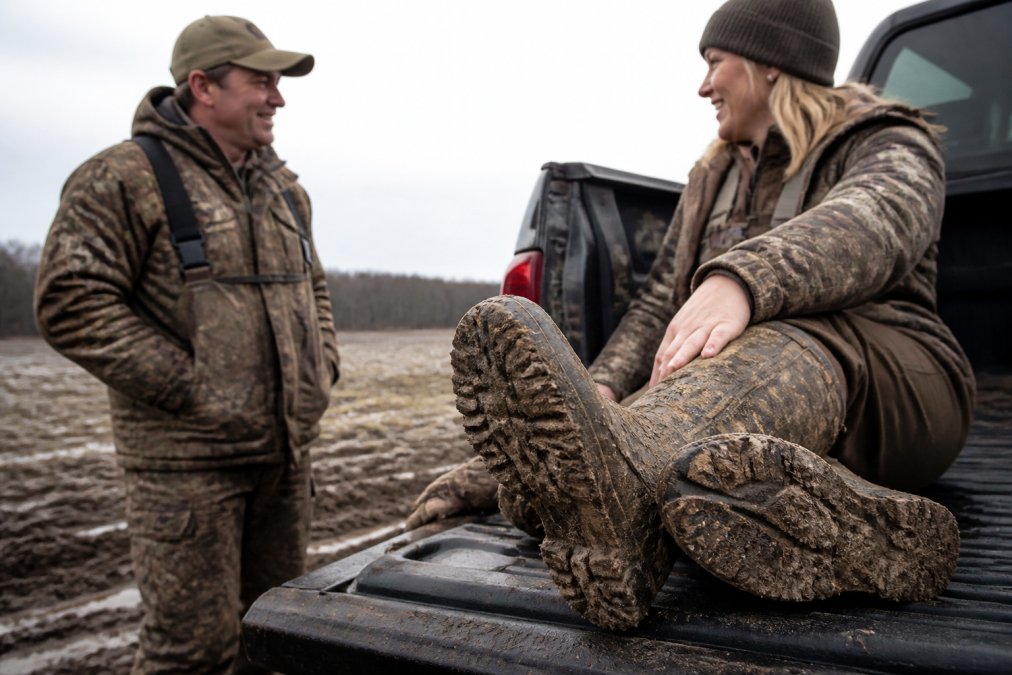
Traction in mud comes down to how fast the tread sheds it. Mud sticks to the outsole, fills the gaps between lugs, and turns a grippy tread into a smooth, wet surface. The boot that wins throws mud off with every step.
Lug Depth, Spacing, and Mud Release
Deep lugs matter, but spacing matters just as much. Wide gaps let mud release as your foot rolls forward instead of packing in. Narrow, tightly packed lugs fill up fast and stay filled, think tractor tire versus highway tire.
Look for a lug pattern with a slight taper, wider at the base, narrower at the tip, so clumps fall away instead of clinging. A heel kick or angled heel brake bites in on descents and wet grass, giving you a split-second of purchase before your weight shifts forward.
Sticky Clay vs. Loose Mud: Two Different Problems
Not all mud behaves the same, and the tread that works in one can fail in the other.
Sticky clay can be one of the toughest conditions for boot traction.
What to Check Before You Buy
Flip the boot over and look at the outsole. Run your thumb across the lugs, if they feel shallow or tightly packed, they'll fill up fast. Check the heel for a defined brake or kick, and flex the sole in your hands; a sole that flexes easily sheds mud better than a stiff plank.
Occupational Safety and Health Administration guidance on protective footwear
Waterproofing That Survives a Wet-Dry Cycle
Waterproofing is easy on day one. The test is what happens after the boot dries out and goes back into the wet.
Membrane, Seam Sealing, and Gusseted Tongues
Many waterproof boot membranes are designed to block outside moisture while allowing some moisture vapor to escape. Sealed seams and a gusseted tongue can also help reduce common entry points for water. Unsealed or damaged seams can become potential entry points for water.
Insulation, Breathability, and the Clomping Problem
Insulation and breathability pull against each other, and that's where most buyers get it wrong.
Fit, Ankle Support, and Arch Support for Uneven Ground
Fit is where a good boot becomes a great one, and it's the part most people rush.
Heel Lock, Sizing, and Thick Socks
A proper heel lock keeps your heel from sliding up and down as you walk, sliding causes blisters and wears out the lining. Lace the top eyelets snug and use a heel-lock lacing pattern if your boot has the extra eyelet.
How to Clean Muddy Outdoor Boots So They Last
Learning how to clean muddy outdoor boots properly is the cheapest way to extend their life, and it takes about ten minutes.
- Knock off loose mud with a stick or boot brush before you go inside. Don't let it dry into a brick.
- Rinse with cool water. Hot water can break down adhesives and leather oils.
- Scrub the upper with a soft brush and a mild soap. Skip harsh detergents.
- Rinse again and let them air dry at room temperature, away from heat.
- Stuff them with newspaper to hold their shape while they dry.
- If needed, apply a conditioner or waterproofing treatment that's appropriate for the boot's material and follow the manufacturer's care instructions.
- Store them somewhere dry and out of direct sun.
Weighing Durability Against Weight and Cost
Every boot is a trade-off between weight, durability, and how much you want to spend. But the durability question is more specific than most guides admit: it's not just "will this boot last," it's "will this boot last through the stuff I actually walk in."
How Manure, Chemicals, and Wet-Dry Cycles Break Down Boots
Field work and farm chores can expose boots to mud, manure, fertilizers and other materials that may be hard on footwear. Repeated exposure, combined with wet-dry cycles, can shorten the life of some boot materials. Cleaning boots after use and following the manufacturer's care instructions can help.
Weight-to-Utility Ratio: How Much Boot Is Too Much
Weight matters more than most shoppers think. A heavier boot is more durable on paper, but if it wears you out by noon, you'll leave it in the truck. The weight-to-utility ratio is the real number to watch: how much boot you're carrying for how much protection you're getting.
Rubber Compound and Abrasion Resistance
Rubber compound and abrasion resistance decide how long a boot survives. Softer rubber grips better but wears faster; harder rubber lasts longer but gets slick in cold weather. A vulcanized rubber lower is a solid middle ground for wet, muddy work, tough, water-resistant, and holds up to repeated wet-dry cycles.
Priority |
What to Look For |
Trade-Off |
|---|---|---|
All-day walking |
Lighter weight, moderate insulation |
Less warmth when standing still |
Standing in cold |
More insulation, taller shaft |
Heavier, warmer feet on the move |
Deep mud |
Aggressive lug pattern, rubber lower |
Stiffer, slower break-in |
Long lifespan |
Full-grain leather, sealed seams |
Higher upfront cost, needs care |
Quick on and off |
Pull-on style, gusseted tongue |
Less ankle support |
Making the Call
If you're in mud and manure every day, prioritize rubber or a rubber-lower boot with sealed seams and a self-cleaning tread. If you're walking long distances in mixed terrain, a lighter leather or synthetic boot with good breathability serves you better, just condition it regularly. Standing in cold, wet ground for hours? Accept the weight and go with insulation and a taller shaft.
Conclusion
Muddy fields don't reward the toughest-looking boot. They reward the one with the right lug pattern, sealed seams, a gusseted tongue, and a fit that keeps your heel locked in place. Get those four things right and you'll stay upright, dry, and comfortable from first light to last.
Frequently Asked Questions
What features make a boot truly waterproof for muddy fields?
Look for a seam-sealed waterproof membrane, a gusseted tongue that keeps water from running in at the laces, and full-grain leather or a synthetic upper treated for water resistance. Rubber lowers are the most dependable for standing water and deep mud. Seams are the first place water gets in, so check that every stitch line is taped or sealed. A boot labeled water-resistant is not the same as waterproof, and it will soak through after a few hours in wet grass or flooded ruts.
What are the traction requirements for muddy terrain?
Deep, widely spaced lugs shed mud instead of packing it, which is what keeps you from sliding. A softer rubber compound grips slick clay better than a hard one, though it wears faster on gravel and pavement. Tread depth around 6 to 8 millimeters handles most field mud, and a defined heel helps on descents into ditches. If you walk a lot of flat, greasy ground, prioritize mud release over aggressive edges. Siping, the small cuts in each lug, adds grip on wet grass.
How do you clean muddy outdoor boots so they hold up?
Knock off the heavy mud while it is still wet, then rinse with cool water. Never bake them by a fire or on a truck heater, since heat breaks down adhesives and cracks rubber. Scrub the uppers with a soft brush and mild soap, rinse, and let them air dry away from direct sun. Stuff them with newspaper to pull moisture out. Condition leather once dry, and reapply a water-repellent treatment when water stops beading. Clean boots last far longer than muddy ones.
Should you size up when buying waterproof boots for thick socks?
Size up a half size if you plan to wear heavyweight wool socks, but no more than that. Too much room lets your foot slide, which causes blisters on long walks and wears through the heel lining. Test fit at the end of the day when feet are largest, and wear the socks you hunt in. You want about a thumb's width between your longest toe and the front of the boot, and a snug heel that does not lift when you walk.