

Table of Contents
- What Safe Outdoor Gear for Young Hikers Really Means
- Best Hiking Shoes for Kids: Fit Comes Before Features
- Layer Up for Changing Weather: Clothing and Rain Shells
- What to Pack for a Family Hike: Light Packs, Water, and Snacks
- Sun and Insect Protection for Small Hikers
- Hiking First Aid Kit Essentials and Safety Basics
- Kids Hiking Safety Tips: Trails, Weather, and Distances
- Five-Item Gear Comparison and a Simple Family Hiking Checklist
- Frequently Asked Questions
Last Updated: October 18, 2026
What Safe Outdoor Gear for Young Hikers Really Means
Safe outdoor gear for young hikers is chosen for fit, comfort, and simplicity first, features second.
Expensive gear does not make a hike safer. A properly fitted boot and a light pack matter far more than a technical jacket with a big price tag.
Here's what to look for in each, plus a checklist to run before you leave the driveway.
Best Hiking Shoes for Kids: Fit Comes Before Features
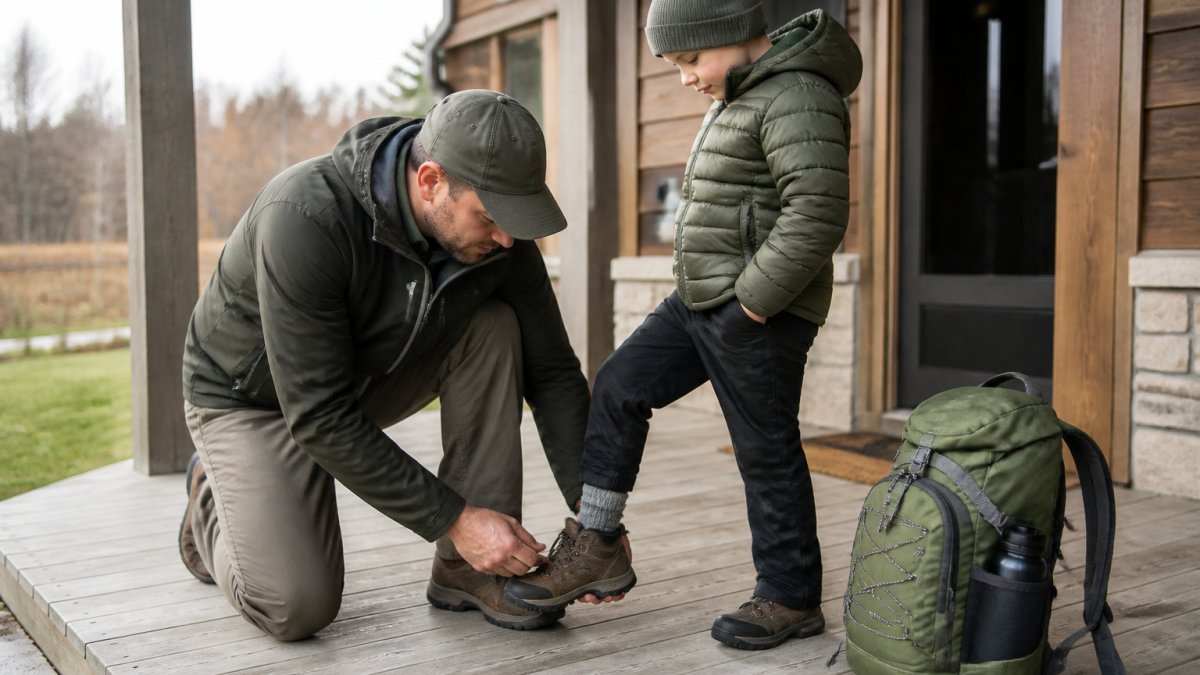
The best hiking shoes for kids are the ones that fit today, not the ones they'll grow into by fall. A shoe that slips at the heel causes blisters and rolled ankles on uneven ground.
How to Check Fit Before You Leave the House
- Press a thumb across the top of the toe box. You want about a finger's width of room in front.
- Have the child walk away and back. Watch for heel lift.
- Check the width at the ball of the foot, not just the length.
Socks matter too. A wool sock like our kids' merino hiking socks manages moisture and temperature, which cuts down on hot spots. Look for a closed toe, a grippy sole, and laces or straps a child can manage alone.

Layer Up for Changing Weather: Clothing and Rain Shells
Layers beat one heavy coat every time, especially with weather that shifts by lunch. A child in a single thick jacket overheats on the climb and freezes at the overlook.
Start with a moisture-wicking base layer, add an insulating mid layer, and finish with a wind and rain shell. Choose a lightweight rain shell that fits your child properly, allows easy movement, and provides protection suited to the forecast. Look for adjustable cuffs, a comfortable hood, and enough room for a warm layer underneath.
Avoid cotton next to the skin. It holds sweat and rain and stays cold. Check the forecast the morning of the hike, then pack one layer warmer than you think you'll need.
What to Pack for a Family Hike: Light Packs, Water, and Snacks
What to pack for a family hike comes down to three things: water, snacks, and a light pack to carry them. The goal is a pack the child can carry without leaning forward or complaining by the first mile.
Pack Weight and Load Limits for Young Hikers
A simple rule: keep a child's pack light enough that they can walk and talk at the same time. If they're puffing, hunched, or grabbing the shoulder straps to hoist the load, it's too heavy.
A common pattern among outdoor educators and scouting programs is to keep a young child's loaded pack to roughly ten percent of body weight, and well under that for kids under about eight.
Age and stage change the picture more than any single number:
- Toddlers and preschoolers (roughly 2 to 4): Carry nothing, or a nearly empty pack with a snack and a folded hat. An adult carries the water.
- Early elementary (roughly 5 to 7): A small pack with their own water bottle and one snack. Expect to carry it yourself by the halfway point.
- Older elementary (roughly 8 to 11): They can carry their own water, snacks, and a light layer for a half-day hike. This is the age where pack fit starts to matter as much as pack weight.
How to Check Pack Fit on a Child
A pack that's the right weight but the wrong size will still wear a kid out. Before you leave:
- Loosen the shoulder straps, put the pack on, then tighten until it sits high and close to the back, not sagging toward the tailbone.
- Check that the hip belt (if the pack has one) rests on the hips, not the waist or ribs.
- Confirm the sternum strap crosses the chest, not the throat.
Adults should carry the first aid kit, the extra water, and the rain gear. Let kids carry a bottle and a snack so they feel involved without being loaded down. Our 32oz insulated bottle keeps drinks cold up to 24 hours, which matters when a kid refuses warm water.

Water and Snack Quantities That Actually Work
A bottle within easy reach beats a big jug in the adult's pack, because kids sip more when water is handy. Offer water at every stop rather than waiting for a child to ask.
Pack snacks that don't crush or melt: trail mix, jerky, crackers, fruit. Skip anything that needs two hands and a lap. Plan one snack per hour plus a backup in the adult's pack, because the snack a child refuses at mile one is often the one they want at mile three.
Sun and Insect Protection for Small Hikers
Sun and insect protection is easy to skip and easy to regret. A long, exposed stretch of trail can burn small arms and necks fast, and bugs can turn a happy kid into a miserable one. Build protection into the routine so it happens before anyone is whining.
Brown Boot Socks Wild - 95% Merino Wool Hiking Socks for Kids and Toddlers →
Cover Up First, Then Add Sunscreen
Lightweight, long-sleeve clothing and a wide-brim hat can help protect exposed skin. Choose sun-protective clothing with a verified UPF rating when available, and use sunscreen according to its label.

For sunscreen, follow the age restrictions and directions on the product label. Many labels direct caregivers to keep infants under six months out of direct sun and to use clothing and shade rather than sunscreen on very young babies, so read the label rather than assuming.
Insect Repellent: Apply It Yourself
For insect repellent, follow the age restrictions and directions on the product label, and apply it yourself rather than handing the bottle to a child. Many labels restrict use on young children or direct that an adult apply it, so the label, not a general rule, is your guide.
A few practical habits can help cut down on bites:
- Time the hike around the bugs. Dawn and dusk are peak mosquito hours in many areas, so a mid-morning start often means fewer bites.
- Dress for the bugs. Long sleeves and pants tucked into socks help on buggy trails, even in warm weather, if the fabric is light.
- Check for ticks at the trailhead and again at home. A full-body check, including hair, waistband, and behind the knees, is the habit that matters most. Follow the label directions on any repellent, and follow public health guidance from your state or local health department for tick removal.
How Protection Needs Change With Terrain and Season
Open ridgelines, water crossings, and exposed rock reflect sun and offer no shade, so plan more coverage there than on a wooded loop. Late-spring and summer hikes in tall grass and brush call for more attention to ticks and long pants. Fall brings lower sun angles and cooler mornings, so a hat still matters but bug pressure usually drops. Check the forecast and the local bug report before you go, and adjust the plan rather than the gear list.
Hiking First Aid Kit Essentials and Safety Basics
Hiking first aid kit essentials for a family hike are modest: adhesive bandages, blister treatment, antiseptic wipes, tweezers, a small roll of tape, children's pain reliever, and any personal medication. Adults carry the kit and make the safety calls.
The Whistle Rule: A Backup Signal, Not a Babysitter
Give each child an age-appropriate whistle attached securely to their backpack or clothing, not on a cord around their neck. Teach them to stop, stay in one place, and blow three short blasts if they become separated from the group. Teach them three short blasts means "I need help." A whistle carries farther than a voice and works when a kid is scared or out of breath. It is a backup signal only.
Children should never hike alone. Adults manage the emergency supplies, watch the weather, and decide when to turn around.
Kids Hiking Safety Tips: Trails, Weather, and Distances
Kids hiking safety tips start with three habits: pick a marked trail, check the weather, and match the distance to the child. A short loop with a fun destination beats a long march with no payoff.
Choose trails with clear footing and a landmark, like a creek or a lookout. Check the forecast and turn back at the first sign of lightning or dropping temperatures.
Five-Item Gear Comparison and a Simple Family Hiking Checklist
Here is the five-category comparison at a glance. Use it to plan a trip, then run the checklist below before you leave.
Gear Category |
What to Look For |
Why It Matters |
Best For |
|---|---|---|---|
Hiking shoes |
Snug heel, toe room, grippy sole |
Helps reduce blisters and slipping |
Every hike |
Layered clothing |
Wicking base, warm mid, rain shell |
Handles changing weather |
Cool or wet days |
Light pack |
Light load, water, snacks |
Keeps kids comfortable |
Any trail |
Sun and insect protection |
Hat, long sleeves, labeled repellent |
Helps reduce sun exposure and insect bites. |
Open, buggy trails |
Safety essentials |
Whistle, first aid kit |
Backup signal and quick care |
All trips |
Simple Family Hiking Checklist
- Check the weather and trail conditions.
- Choose a trail suited to your child's age and ability.
- Make sure shoes fit and socks are comfortable.
- Pack appropriate clothing layers and rain protection.
- Bring enough drinking water and snacks.
- Pack sun and insect protection.
- Carry a first aid kit, medications, and a charged phone.
- Bring a trail map and teach children what to do if separated.
- Keep whistles attached safely to backpacks or clothing.
- Set a turnaround time and keep children within sight.
Common Mistakes to Avoid
- Buying shoes a size up "to grow into." Loose boots cause blisters and falls.
- Overloading a child's pack. Keep it light enough to walk and talk.
- Skipping the rain shell because the sky looks clear.
- Forgetting the whistle or leaving the first aid kit in the truck.
Frequently Asked Questions
What gear does a child need for a day hike?
A child needs properly fitted hiking shoes, weather-appropriate layers, and a light backpack holding water and snacks. Add sun and insect protection, plus a whistle and basic first aid carried by the adult. The pack should be small enough that the child can carry it without leaning forward, and the adult should carry the heavier emergency supplies. Keep the list short and check it before every trip, since changing conditions can add or remove a layer.
How should hiking shoes fit a child?
Look for a thumb's width of space between the longest toe and the front of the shoe, a snug heel that does not slip, and enough width that the toes can spread. Have the child try shoes on with the socks they will hike in, and recheck fit every few months because young feet grow quickly. Avoid buying several sizes up, since a loose shoe causes blisters and rolled ankles on uneven ground.
How much water should kids bring on a hike?
Bring more than you think you need and plan to refill where possible. A practical approach is a small bottle the child can carry plus a larger bottle in the adult's pack, with sips offered every 15 to 20 minutes rather than waiting for thirst. Hot days, high elevation, and long climbs raise the need. Check that the child can open and close their own bottle without help.
What safety items should adults carry when hiking with children?
Adults should carry a basic first aid kit, a whistle for each child, a charged phone, a map or downloaded trail map, extra layers, and enough water and food for the whole group. Children should know to stay where they are and blow the whistle if separated, and adults should set the meeting point before the hike starts.